Once upon a time in a far away land, there lived an evil king, named Leer. His long-suffering wife, after bearing 12 sons and one daughter, gratefully expired, escaping her cruel husband at last. He was a distrustful man, and fearful that once his sons grew up, they would try to take away his crown. To be sure that they would always stay children, he did not send them to school or teach them how to fight with swords, as young princes should. The children played with diamond pencils on golden slates and looked at pictures in glorious book with gilded covers, that cost a fortune. In their ignorance, the boys were content and happy.
The princess, whose name was Hella, was not happy at all. King Leer had promised himself that he would never again marry anyone who was not as beautiful as his wife had been. His courtiers searched the kingdom high and low, but they could find no one who matched the dead queen’s loveliness. The only person who resembled her, was his beautiful daughter. In the darkness of his heart, he resolved to marry her when she was older, no matter what she might think of it. The way he looked at her made her feel uneasy and sick. She did not know what to do.
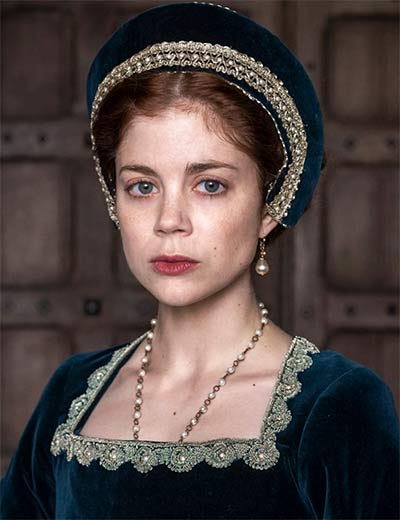 In the meantime the queen of a neighbouring country came to visit the castle. She seemed stern and cold to the children, who were afraid of her. The king found her enchanting, and remembering how lonely his bed was, asked her to marry him. “Perhaps she will be dead by the time Hella is of age,” he thought to himself. The wedding was to be a lavish one, with many guests from both countries. The children, however, were kept in a separate room, and not allowed at the ceremony.
The servants whispered that the reason was that the wedding was to be celebrated in the old religion and not within the church. The archbishop was furious. He thought the king should provide a better example for his people. But the His Highness seemed entranced by his new bride, and would not gainsay her wishes.
The aromas drifting from the kitchen were enticing, especially that of the wild boar which had been caught and roasted particularly for this occasion. It was to be served with an apple in its mouth, symbolic of its sacred heart. But all the children received were cups with a little sand in the bottom. The brothers complained bitterly, but Hella could only wonder silently at what this could mean for their future.
Very soon after the wedding, the new queen summoned Hella and said, “In my country, all high born children are sent away for fostering to a good family, until they come of age. I have had your clothes packed. You will leave today to live with our vassals on the farthest corner of our lands.” Hella could say nothing. On one hand she was filled with trepidation at being forced from her home. But, she was secretly relieved to be leaving this outlandish woman and her father.
She left that day, accompanied by the wailing of her brothers, who were heartbroken to see her go. They shrieked and shook their fists at their step mother, “Why have you done this thing? Why did you ever come here? Why don’t you go back to where you came
from?”
“Perhaps I shall,” she replied, “but not before my work is done. It is time for you, too, to go out into the world. But you shall go as great, voiceless birds.” With a widdershins, spiralling motion of her arm, the princes shrunk and bulged, their necks elongated, and they turned into great, white swans. “Begone!” she commanded, and with sad cries, they rose in a feathery cloud, circled the castle and headed north into a dense forest.
Years passed, and in her foster home, Hella grew in beauty and accomplishment. At last she was taught the things a princess should know. She no longer had much time to think of her old life as she was kept busy and happy from dawn to dusk. She began to think of her foster home as her real home, so it was an unpleasant surprise to her one day, when a dusty messenger arrived from her father’s castle. It seemed he was getting old, and wanted to see her now that she had become a young woman. This made Hella very uneasy- afraid, really, but she could not refuse.
When she arrived at the castle, the only person to meet her was her step-mother. Although Hella had changed a great deal, her stepmother looked precisely the same. Hella still thought the Queen looked stern, but now that she was older, she could sense a serenity about the woman that she had not noticed before. After they had greeted each other politely, the queen asked, “Would you like a bath? I am sure you are tired from your travels.” Hella thought that would be wonderful.
Unbeknownst to Hella, the Queen was very aware of her fear, as well as of the evil thoughts in the king’s heart. “This shall not be,” she promised to the four directions. “By my Will, this shall not happen.” As Hella was disrobing for her bath, the Queen put three magical toads in the water. “Sit on her heart,” she said to the first, “so that she will remember no love of her sire.” To the second she said, “Sit on her forehead, so that what she sees, she will not recognize.” To the third, she commanded, “Sit on the crown of her head, so that no sense or knowledge will escape and betray her into recognizing the king.” As soon as the little toads sank under the surface, they became invisible, and did as they were told. Hella came from her bath feeling refreshed, with a considerably lighter heart, though she could not have told anyone why.
Her happiness was shortly replaced by serious bewilderment, as the moment she was dry, the queen proceeded to tangle and snarl her hair, rubbing it and her skin with rancid fat and walnut juice. She dressed her in a ragged gown, purposely tearing the hem; and she wrapped an old shawl around her shoulders. Looking like a beggar girl, who had not seen water for months, she was taken to be presented to the king.
 King Leer had dressed himself foolishly for this momentous occasion, imagining himself to be a young bridegroom again. Every finger had a ring, and his stockings boasted brilliant garters. His neck was burdened with every chain of office, medal of valour and crown jewel the treasury possessed. He was perfumed and pomaded, his lips were carmine (though his teeth were yellow) and from his ears hung tear-shaped grey pearls, from far oceans. Chamber music was being played sullenly in the corner by some farmers
because the musicians had all died. He waited impatiently, passing the time by torturing his pet, a scabrous old monkey which was tied to the base of a pillar. Far enough away so that it could not bite him, but close enough so that he could poke it with a stick.
The far doors opened with a flourish. “Here comes “that woman,” he hissed to himself, “What does she want? And who is that perfectly dreadful creature with her?” The queen said nothing, but brought Hella very close to her father. While she looked at him with a mixture of wonder and amazement, he returned her appraisal with undisguised horror. Snatching a scented lace handkerchief from one of his many pockets, he shrieked, “Take it away! Take it away! What did you bring it here for anyway?” As he rushed from the room, he very nearly tripped over the monkey, who did not lose the opportunity to give him a painful bite on the leg .
The queen took Hella to a back gate of the castle and sent her on her way, saying, “You must now make your own way in the world. Your brothers have been turned into swans and have flown away. Your fate and theirs is now in your hands. You have a long and hard journey ahead of you.” And with that she closed the little wooden door, leaving Hella alone in the dusk.
As she sadly took to the road, she did not see the raven which flew out of the castle window to circle the tower three times and head toward the dark forest ahead of her.
CHAPTER TWO
The forest was dim and silent and she became fearful as night drew closer. She heard nothing, only the sound of the wind sighing in the great trees. It sounded to her like the voice of her mother, “Hella…oh Hella.” As the darkness enclosed her, she huddled in the hollow of an ancient tree. She had a dreadful sleep, always seeming to see the unblinking eyes of birds, staring at her in the dark.
When she awoke, cold and shivering the next morning, the first thing she saw was an apple-cheeked old woman with a willow basket on her arm, gathering berries. Her hands were gnarled like old wood and she was stooped over like an ancient thorn; yet the expression on her face was kindly. “Good morning,” the princess called politely, “Have you seen any swans in this forest?”
“Yes, indeed,” the old woman was glad to tell her, “I have. Only yesterday, I saw twelve beautiful swans with crowns on their heads, swimming on the river nearby. Would you care for some berries?”
She obligingly lead Hella to the river, but when Hella turned to thank her, the old woman had melted into the forest and was no where to be seen. With a shrug, she began to walk beside the river to the sea. It was almost dusk before she heard the sound of the ocean waves.
The shore was covered with small round pebbles, which made walking difficult. Yet, when she bent to examine them, each was beautifully speckled and rounded, like the egg of a quail. “It has taken the water many years to create such beauty out of stone,” she thought. “I must learn that kind of patience in order to free my brothers.”
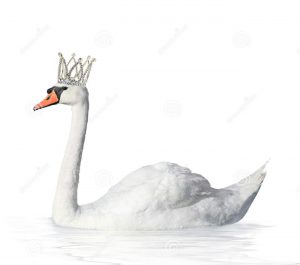 Suddenly, far out over the water, she heard the cries of swans, high in the air, but heading for shore. She hid behind some grasses, and watched them land. As the sun set, she witnessed a magical transformation , and there stood the twelve princes. She rushed weeping into their midst. You can imagine their surprise and delight, when they discovered that this wretched beggar- woman was actually their sister.
That night, as they gathered around a driftwood fire, their story unfolded. “We were angry and full of despair at first, but gradually, we learned that the world is a vast and wonderful place. We have been to lands and seen things that our books never showed us. But, we still yearn to be men again, and walk on two legs.” It seemed that they did not live in the forest, but in another wonderous country, far to the north, two days’ flight away.
They only visited their homeland once a year. The problem was that every night at dusk, they became human and so, had to be on land. Between this country and theirs was a tiny rock on which they landed and spent a cold, wet night, before flying on.
They had planned to leave again the next day, but could not bear to leave their little sister behind. The princess conceived a plan. She told them of the kind woman in the woods with her willow basket. The brothers looked at each other over her head, but said nothing. “We can weave a basket of willow like hers, ” she said, “big enough to carry me. You could take me with you!” This they agreed to do, and spent the rest of the night working.
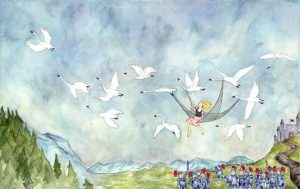 The next day, they were in the air shortly after dawn. The swans took turns carrying her, and when he could, her youngest brother, Bran, would shield her from the sun with his shadow. She felt no fear, although they were far above the breast of the ocean.
Giant leviathans, ploughing their way through the waves below, looked like tiny shrimp. “Really, it all depends on how you look at something,” she thought. Later in the afternoon, they passed a vast bank of icy clouds, moiling and roiling in limitless space. In the centre was a fabulous palace of mother-of-pearl. Its walls glowed as if lit from within and the diamond window panes glinted and winked in the sunlight. There were gardens of huge white blossomed flowers, which nodded as they passed. Her brother
s told her that this was the palace of the Fata Morgana, and that no one dared to enter it.
But now, the light was beginning to fail and there was a storm on the sea below. Hella began to be afraid; and yet, just as the last rays of light were extinguished from the sky, they landed heavily on a tiny rock, just big enough for them to stand. The princes regained their human shape, and the thirteen of them huddled together clutching the basket, as the freezing spray soaked them through the whole night long. It was with great relief that they watched the rose of dawn lighten the sky the next morning.
After another long day of flying, they finally sighted land and alighted beside a cave, deep in a cedar forest. Hella kissed the ground and thought to herself, “For now, this will be my home.” That night, she had another strange dream.
The Fata Morgana, a fairy too awesome to be beautiful, floated just outside her cave. Hella thought she looked familiar, but said nothing. The Fata Morgana addressed her thus:
 “The challenge I place on you is to free your brothers from enchantment. Do you see the wild nettles growing around the mouth of this cave? Only these and nettles found in graveyards on a full moon must be made into flax. You must pick it, though it will burn you, tread on it with your bare feet, though it will surely blister your soles. Then you must spin it into yarn and make shirts for each of your brothers. Only shirts made in this manner will free them. Throw them over the swans and the charm is broken.
All the time you work, you must not speak, laugh or cry out loud. If any sound passes your lips, it will be as if a murderer had stabbed them in their hearts. The choice is yours. Do not fail.”
With that, the Fata Morgana floated up into the clouds, and Hella awoke, determined to start her task. The sun was already up, her brothers had flown, and she grimly began to pick nettles.
CHAPTER THREE
When the brothers returned to the cave that night and saw the terrible state she was in, they were horrified, but they knew she did this for their sakes. Bran, the youngest, wept with pity, and where his tears fell, her pain was eased for a short time. Every day, she picked nettles, and spun the fibres into yard, in readiness to weave them into shirts.
One morning as she was working, she heard the unmistakable sound of hunting hounds baying deep in the forest. Shivering with fear and foreboding, she hid in the cave, but to no avail. Very soon, three huge, snow-white dogs, with ears as red as blood appeared in front of the cave, barking until the hunters came on their grey horses.
There were many of them, but there was one who drew her eye. He was Arawn, the king. He had never seen such a beautiful woman, despite her rags and tatters and lacerated hands and feet. When he asked her what her name was, she did not answer, but shook her head. He thought she was mute, but decided that it did not matter, he wanted her for his wife. When he told her that he would take her to his castle, she shook her head and two large tears rolled down her cheeks. “She will soon cheer up when she is clean an
d warm,” thought the king. He swung her up in front of him and galloped home. In silence, she lamented her terrible fate.
Hella was devastated. Her work of a week, the nettles she had so painfully collected were all at the cave. How could she free her brothers, now? Like a lifeless doll, she allowed her self to be washed and dressed in beautiful silks and fine laces. That whole day, she did not smile until the king, showing her around the castle, opened a door to a little green room. There, in the middle of the floor was her bundle of nettles and yarn! “I thought that might make you smile,” he said, “This room was made especially so that you could come here and feel as if you were at home in the woods.” When he saw Hella smile, he decided that the wedding should take place the very next day.
Meanwhile, the Archbishop was having a terrible life. The country priests who were not much better educated than the peasants, had been reported dancing around the fields to insure the fertility of the corn and grain. He had never heard of anything so ridiculous, and swore to stamp out these pagan practices. The king chose that moment to announce his marriage to the mute woman of the woods. The Archbishop suspected her of being a pagan, probably a witch, and tried to dissuade him, but Arawn was firm in his resolve.
CHAPTER FOUR
The wedding took place as King Arawn wished. The bride was very beautiful, but naturally, could not say, “I will.” When the time came to place the crown on her head, the Archbishop, who was still very angry, pressed it onto her brow so hard that the pain was blinding. And still, she did not wince or say a word. Silently watching from the front pew, was the King’s mother, the Old Queen. The people stood away from her. She was known as a keeper of dark secrets and was said to know many things forbidden by the priests. After the ceremony, she did not linger for the banquet, but quietly disappeared.
From that day on, life was good to Hella. She was the Queen, so people were kind to her.
Every spare moment was spent working on her spinning and weaving, and although there were those who thought her strange, no one interfered. She and the King were happy together, and were expecting their first child. One night, she realized that she was almost out of nettles. She would have to collect them from the graveyard, where they grew abundantly. She decided to wait until the night of the full moon, not only because their magical power would be at their height, but because there would be enough light
to see.
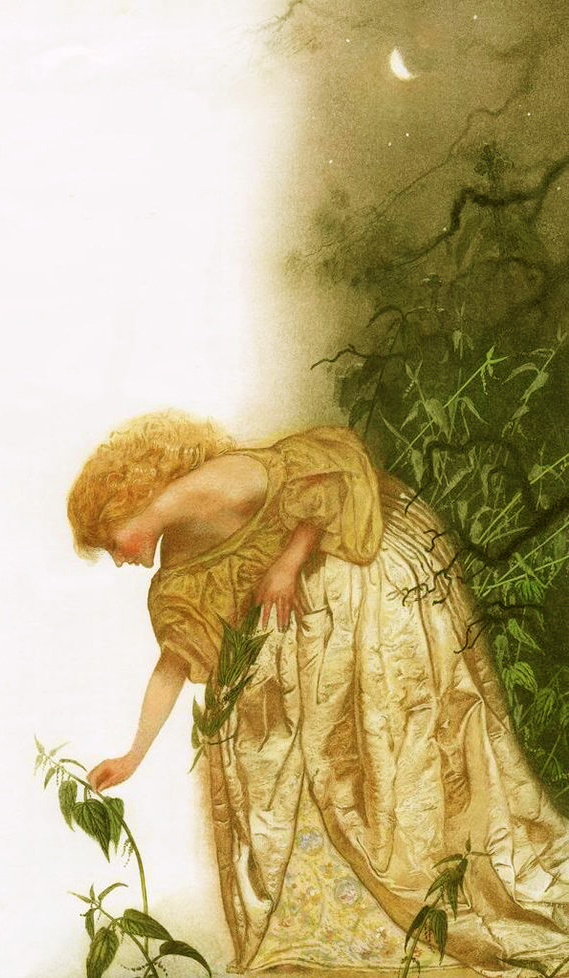 She waited until midnight on the night the moon was at its peak, and bundling herself in a cloak, took a basket and furtively left the castle. A cold wind made her shiver. She could hear strange rustling in the underbrush. After what seemed like hours, she finally reached the graveyard and froze in horror. There, digging in the new graves with their white, bony hands were Lamias, eating the flesh of the dead. Their long, scaley tails glinted like metal and she could hear the crunching as they broke the bones to suck out the marrow. Shuddering with revulsion, she hurried to the nearest thicket of nettles and picked frantically, and left the second her basket was full.
Unbeknownst to her, she was not the only person abroad that night. Watching her from the castle tower was the archbishop, his suspicions verified. In the deep shadow of an ancient mausoleum a few steps from where she had harvested the nettles, stood her mother-in-law. Both watchers were satisfied, but for very different reasons.
CHAPTER FIVE
The next morning, the archbishop demanded to see the king, to tell him what he had seen in the graveyard the night before. The king only laughed heartily, loving his wife too much to accept any criticism of her. Soon after, she gave birth to their son, a lovely, fine baby who resembled his father. The King thought his cup of happiness was full to the brim. All too soon, he would sup on the dregs.
Hella awoke one dark night, as if in a dream, to see her mother-in-law standing over her bed, with the baby in her arms. The old Queen seemed to reach toward her, but Hella drifted deeper into sleep. The next morning after entering the room, the maids began to scream . The baby prince was gone from his crib and the Queen had blood all over her mouth! The Queen was inconsolable, the king was maddened with grief, yet still he would not listen when the archbishop whispered of cannibalism. All the while, as
time passed, Hella worked at the shirts, spinning and weaving, weaving and sewing.
Again, in time, she found that she was with child. Again, she gave birth to a healthy baby. She was determined this time, never to sleep while the maids were away. Never would this child disappear as the last. But the nights of long and arduous toil had taken their toll, so that one night she did nod off. In her dream, she seemed to see her mother-in-law reach into the crib and take the baby into her arms, turn slowly…and reach toward her…. In the morning, the baby princess was no longer in her crib. Hella’s face was smeared with blood, but still, the king would not listen to the archbishop; though by now his heart was deeply troubled.
Pregnant with their third child, Hella continued to work, her task almost complete. She had only one more shirt to finish, that for her youngest brother, but she was almost out of nettles. The night that the moon was full, she left the castle to make one last trip to that dreadful graveyard. The archbishop had been watching for this opportunity for months. As he saw her leave the gate, he ran to the King, crying, “Now you must see for yourself! She is going to the graveyard to despoil the dead bodies! You
must believe it if you see it!” The King threw a robe around his shoulders and silently followed the Archbishop into the night.
He saw Hella flitting along in the moonlight ahead of them, saw her open the gate to the graveyard and saw the Lamias at their grisly feast. He could watch no more, and stricken by grief, returned to the castle, saying, “She is with child, we can do nothing for now.” Hella knew in the days that followed, that something had drastically changed between them. The king was distant and cold, never spending time with her alone. “Soon,” she thought, “this will be done and I can tell him everything myself.” That night that she went into labour.
A beautiful baby prince was born the next morning, and this time, the King would take no chances. A guard was in the room at all times. The Queen was never alone with her baby, not even for a minute. This was a relief to her as well, as she felt safe from the evil dreams of her mother-in-law and safe from herself. “One more sleeve and I am finished. Seven years is a very long time.” One night, in the dark of the Moon, the guard fell into a heavy sleep, leaning against his pike. The Queen lay as if dead, while the baby gurgled in his crib. The Old Queen entered the room silently, took up the baby and leaned over the mother’s sleeping face, whispering, “It is almost over for you.”
The proof was undeniable. The third baby was gone and the Queen, groggy-eyed and blood stained. The King could refuse to act no longer. Hella was thrown into the deepest, darkest, dankest, dismal dungeon. When they dragged her down the stairs, they threw her bundle of shirts after her, crying, “There, Witch! See if your ugly spells and sorcery can help you now!” Hella had never been so glad of a cruelty in her life. She continued to spin all that day and into the night. Mice brought her the threads that she
could continue to weave without reaching.
In the town square, bundles of wood were piled high and thick around a stake. The executioner mended his black leather hood, ready to burn the Queen as a witch and a cannibal.
The next morning, she was thrown into a tumbrel drawn by a bone-weary old nag and paraded through the streets, still weaving the last shirt. The crowds were thick along the way to the execution ground and they shrieked, “Look at the witch! Tear her to bits!” There was a bestial roar and a surge of bodies towards the cart. Out of the sky plummeted twelve huge swans, beating at the mob with their wings. The crowds fell back, silent and ashamed. Perhaps the swans were a sign from Heaven? The nag plodded on.
CHAPTER SIX
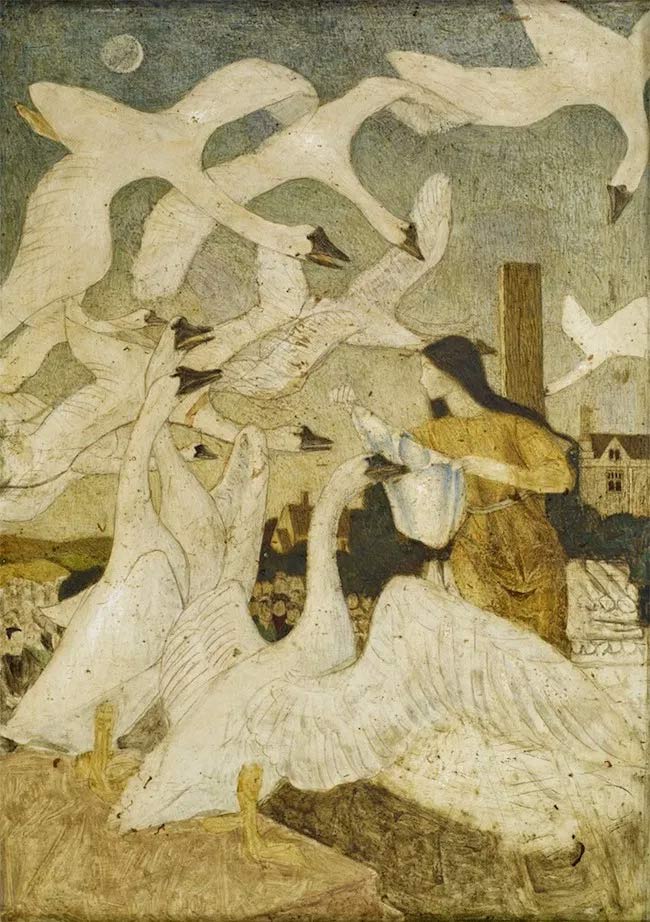 At the stake the executioner untied her wrists. Frantically, she broke free of him and threw the shirts over the swans, each one turning into a man as she did so. The smallest was left with a wing instead of a right arm, as she was unable to complete her task. The air was filled with the scent of roses as every branch on the funeral pyre burst into great red blossoms. The King rode up on his stallion. Hella, ragged and pale, looked at him and for the first time in seven years, croaked, “I am innocent!”
Then, she fell like a stone, dead.
In horror, the King leaped from his horse and ran to where she lay, surrounded by her brothers. Weeping and overcome by guilt, he lay a rose on her breast and begged her forgiveness. After a moment, her eyes opened as she was restored to new life. The crowd roared with joy and it was with difficulty that a path was parted for a tall, serene, dark-haired woman, leading two little children and carrying a tiny baby.
The children were returned to their parents, the Queen to her King and the swans to their human forms. When they turned to thank the lady, she had disappeared. The Old Queen was never seen in the castle again. Queen Hella and King Arawn ruled wisely for many years and they all lived happily ever after.
THE END